
It’s World AIDS Day. It reminds us that talking about HIV in communities of color can still be challenging. Dr. Alftan Dyson, head of strategic medical partnerships at ViiV Healthcare, says people are often surprised HIV is still a thing. “Well, yes, it is a thing. And to the tune of, we have about 39,000 new HIV diagnoses just in the US alone each year,” Dr. Dyson said.
Dyson joined Tamar Braxton and others for a panel called Breaking the Silence, presented by ViiV Healthcare, earlier this year to raise awareness of the HIV epidemic, the taboos and stigmas around prevention, and the importance of mental health.
Taboo & Stigma in Communities of Color
Dr. Dyson believes the other reason that we don’t hear as much about HIV is because of the communities that are impacted. “Communities of color, in particular, struggle with talking about sexuality, sex, and sexual health in positive ways,” she said.
“A third thing would be stigma, not just around the HIV diagnosis itself, and just in general, like it’s a barrier. I often tell people, HIV is not actually what’s going to cause someone you know to lose life; it’s actually going to be the stigma,” Dr Dyson continues.
“Because you have this stigma that prevents you from seeking care. Sometimes there’s a stigma that prevents you from seeking prevention options.”
Forty Years of HIV Advancements
There is fear for many surrounding HIV because they can recall the early years of the disease when those diagnosed had short life spans. But things have changed. “We’ve come to a place now, 40 years later, where we have good antiretroviral therapy, so people who are living with HIV can thrive and do well on antiretroviral therapy, on their medications, and as long as they’re on medicine and achieving undetectable viral loads,” Dr. Dyson said.
Bianca Ordoñez said, “Part of it is the stories we hear about people with HIV.” “In news stories, we usually see the trauma, the fear, the shame, the moment of that diagnosis, how it destroyed a person’s life. And while that can be true, and while that can be part of the story, it’s not the full story,” she explained.
For example, I’m in a sero discordant relationship, which means that I’m HIV positive and my husband is HIV negative,” Ordoñez said. “Together, we have a beautiful, healthy, HIV negative baby girl. So when telling the story of people living with HIV, I would really rather you guys include HIV as a comma instead of a period.”
Why Tamar Braxton is So Vocal About HIV and HIV Prevention
We know that a lot of what Tamar Braxton does is unplanned, and that was the case with her viral Snapchat video. She told the crowd at NABJ.
“I had no idea that going on my Snapchat, figuring out if someone I was dating was 100,000 other people. It just so happened to go viral, helping this sister feel less alone. To help her understand that her purpose is for a purpose.”
But she also mentioned the media’s obsession with clickbait. “We like stories that are going to get traction. But the truth is, a journalist’s job is to bring the news and what is not news about HIV and HIV prevention. So I’m here to help normalize these conversations and make people less uncomfortable about them,” she said
“Why not speak about something important to our community, and that is important to me now, and I mean, I’m going to show up here every time, and so this is a normalized conversation. Having uncomfortable conversations doesn’t make you different; it makes you strong and powerful.”
The singer mentioned data Dr. Dyson shared: at the end of 2023, only 11% of Black folks who could benefit from HIV prevention had received it, whereas 70% of their white counterparts received it. “That’s news. That’s important information to share in the community.”
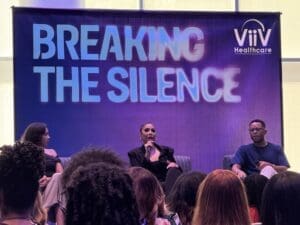 Panelist Tamar Braxton lit up the stage with her powerful voice and perspective. Photo courtesy of ViiV Healthcare.
Mental Health Must Be Included in the HIV Conversation
Yolo Akili Robinson from The Black Emotional Mental Health Collective shared some of the ways they teach in the community. “We have what we call healing circles. So while we think it’s very important to have individual care, you sometimes need to sit in a one-on-one situation. What we do is create collective spaces led by wellness practitioners, therapists, psychiatrists, and other professionals with different healing modalities,” he said.
“And we say, bring your mama, your cousin, your uncle, all them, because we’re going to learn about grief. We’re going to learn about trauma. We’re going to learn about HIV stigma together, as opposed to in these individualized scenarios. We’re going to learn how to process and reframe our emotions together,” Robinson said.
Communities need to be able to move through the uneducation and grief and feel safe.
 Moderator Justin Carter of The Shade Room led our panel through an engaging, thought-provoking discussion. Photo courtesy of ViiV Healthcare.
Caption opening image: Our incredible panelists captured after an inspiring discussion (from left to right): Justin Carter (moderator), Bianca Ordoñez, Tamar Braxton, Yolo Akili Robinson, and Dr. Alftan Dyson. Photo courtesy of ViiV Healthcare.











 English (US) ·