
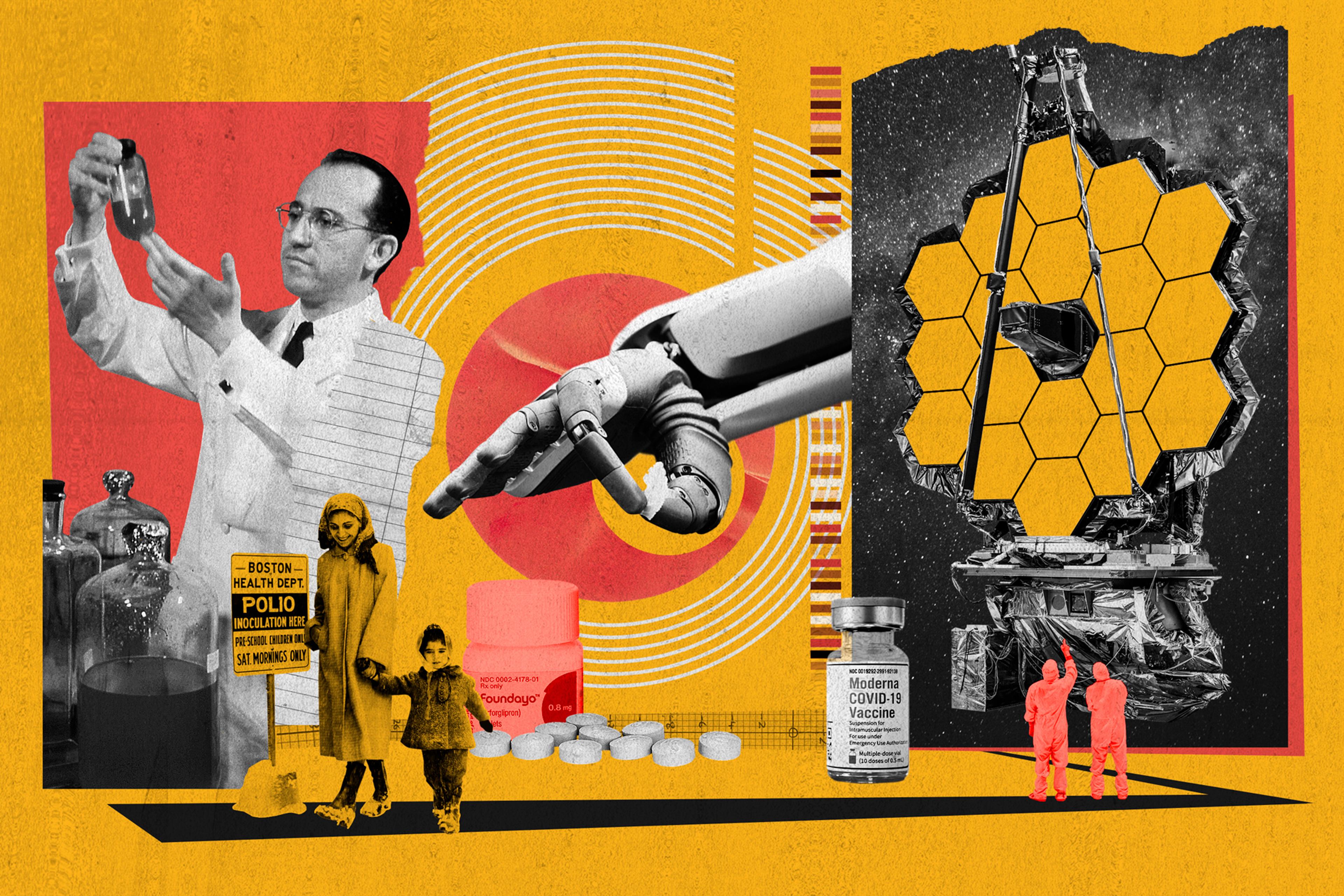
Ahead of the 250th anniversary of the founding of the United States, we asked scientists, scholars, researchers, and doctors to tell us about the discoveries and developments that define this moment in American science and health. From new tools for exploring the far reaches of the cosmos to innovations changing our understanding of our very selves, these are their answers.
GLP-1s
Selected by Emily Oster
Health-wise, recent decades have been dominated by a rise in obesity and associated metabolic disease, significantly affecting the life and health span of Americans. GLP-1s provide the first possibility for a widespread improvement in these issues. Beyond this, it increasingly seems as if they may have wider effects on alcohol and substance abuse and other diseases. Continued understanding of this will reshape how we think about health, food, and beyond.
Oster is an economist, author, and professor at Brown University.
The convergence of artificial intelligence and biology
Selected by Dr. Pardis Sabeti
American history is marked by crucibles, from the Industrial Revolution to the atomic age, in which both scientific possibility and human character were subjected to extraordinary pressure. Today, we are living through another one that will define our shared future. AI could help us outpace disease, accelerate discovery, and save lives, but it also opens the door to catastrophic misuse, including via biological threats and bioweapons. The question is whether we can survive our AI-shaped technological adolescence by guiding this power toward cooperation and care rather than competition and mutual destruction.
Sabeti is a computational biologist, geneticist, and core member of the Broad Institute of MIT and Harvard.
Vaccines
Selected by Bill Nye
As we celebrate our nation’s 250th anniversary and how far we have come, I’m thinking about how polio vaccines changed my life and messenger RNA vaccines probably saved it. These advancements are a testament to our country’s position at the forefront of scientific discovery. Today, they must serve as a reminder of the importance of investing in medical research and protecting public health.
Nye is a science educator.
Big Math
Selected by Steven Strogatz
The defining scientific advance of our moment is the rise of a new style of math—supercharged by computers—that can find structure in enormous datasets. These hidden codes now run our world. Born from the American tradition of scientific ambition and ingenuity, they speed us on our way by GPS, help doctors detect breast cancer earlier, and coordinate the delivery of food, medicine, and packages, forming an invisible architecture that supports everyday life.
Strogatz is a mathematician, author, and professor at Cornell University.
Open-source data
Selected by Kareem El-Badry
Physics and astronomy have become data sciences. Facilities like the NSF–DOE Rubin Observatory, the James Webb Space Telescope, and the Laser Interferometer Gravitational-Wave Observatory produce enormous quantities of data every day (or night). These data are accessible to anyone with an internet connection, accelerating discovery and democratizing the scientific process.
El-Badry is an astrophysicist and assistant professor of astronomy at the California Institute of Technology.
Federal investment in research
Selected by Ellen Ochoa
What defines where we are as a country at 250 is not a single innovation; in fact, it’s not a what at all, but a how. I have seen firsthand how American innovation has flourished because of investments over decades by the U.S. government in basic and applied research. That model has produced enormous benefits and new industries associated with GPS, the internet, weather forecasting, medical imaging and preventive therapies, advanced manufacturing, and new computing paradigms. Just as important to our national psyche is the awe and inspiration resulting from NASA and NSF collaborations, such as the black hole images and the recent Artemis II mission.
Ochoa is a veteran astronaut, former director of NASA Johnson Space Center, and former chair of the National Science Board.
The James Webb Space Telescope
Selected by Tim Folger
With a mirror more than five times larger than that of the Hubble Space Telescope, this incredible instrument allows astronomers to observe the oldest and most distant objects in the universe. In the roughly four years since its launch, the JWST has already provided astonishingly beautiful images of ancient galaxies and stellar nurseries. It is an exhilarating technological tour de force: an eye on the cosmos and an embodiment of human curiosity. Will our society ever fund anything like it again?
Folger is a writer and the former series editor of The Best American Science and Nature Writing.
Vaccines
Selected by Kizzmekia Corbett-Helaire
Maurice Hilleman’s development of more than 40 vaccines—credited with saving millions of lives—captures a defining thread of American history: the nation as a global engine of vaccine innovation and public health progress. In today’s moment of growing vaccine "inquisitiveness" and declining uptake, his legacy is both a reminder of what American science can achieve and a challenge to rebuild public trust so those lifesaving advances continue to reach everyone.
Corbett-Helaire is a viral immunologist, an assistant professor at Harvard’s T.H. Chan School of Public Health, and a Howard Hughes Medical Institute Freeman Hrabowski Scholar.
Our evolving notion of “intelligence”
Selected by Alison Gopnik
A popular current idea, inside and outside the tech world, is that there is a single thing called “intelligence” and that creatures, artificial or natural, have more or less of it. This was a common explanation in folk or everyday theories, as well as in early scientific ones, but as research progresses, cognitive science has moved beyond the simple notion of “intelligence.” Scientists now describe varied, complex cognitive capacities that serve different functions—many different “intelligences” that trade off against each other. The popular discourse around whether artificial general intelligence (AGI) is possible or whether IQ is genetic is not just wrong; it’s fundamentally misconceived. Moving to the scientific picture could reshape the way we think about both people and machines.
Gopnik is an author, professor at the University of California, Berkeley, and a member of the Berkeley AI research group.
Cerebral organoids
Selected by Latif Nasser
For all the technological marvels we are capable of (and all the marketing puffery of AI executives), we have not come close to making anything as astonishing and versatile as the human brain. That said, in the last decade or so, researchers have managed to grow tiny pea-sized balls of human neural tissue, known as cerebral organoids, that are essentially scaled-down versions of what’s in our heads. These organoids have immense potential. Scientists can now experiment on a mini version of a patient's brain, or link a mini brain up with organoids of other body parts to see how they interact with each other. Some tech companies even think that we should replace silicon chips with brain organoids. Somehow, organoids feel simultaneously like a miracle, a robust new tool, and the start of a sci-fi thriller—on-brand for this moment.
Nasser is a writer, researcher, and co-host of WNYC’s Radiolab podcast.
Advances in transplantation
Selected by Dr. Robert A. Montgomery
Xenotransplantation (gene-edited pig organs), manufactured organs, and bioartificial organs (3D-printed or biologic scaffolding) will create abundance, bringing to an end the needless suffering and death caused by the current scarcity of human organs for transplantation.
Montgomery is a transplant surgeon and director of the Transplant Institute at NYU Langone Health.
The transformation of biology into an engineering discipline
Selected by Feng Zhang
We are at the beginning of a profound shift in how we approach human health. The ability to read and write the genome, measure biological processes with unprecedented resolution, and use AI to make sense of enormously complex biological data is allowing us, for the first time, to tackle health challenges from first principles, rather than through the trial and error and serendipity that defined the process until recently. This revolution has been powered by America's unique engine for innovation. Decades of robust federal-funded basic research, vibrant biotech ecosystems, world-class talent drawn from across the globe, and a culture that encourages scientists to translate discoveries into real-world impact have laid the foundation for a future in which we can not only treat disease but actively enhance and sustain human health.
Zhang is a molecular biologist, neuroscientist, and professor at MIT.
Genome sequencing for cancer treatment
Selected by Dr. Reshma Jagsi
One of the greatest innovations transforming modern American health care is the ability to rapidly and inexpensively sequence the genome; this has had tremendous implications for many aspects of medicine, including the prevention and management of cancer. Not only does germline genetic testing now permit the identification of patients at high risk for developing cancer, so they can pursue prophylactic approaches, but the ability to sequence the tumor genome also unleashes an extraordinary armamentarium of individualized, targeted therapeutic approaches. So many more Americans are not just alive but living their best lives thanks to the scientific advances rooted in the recognition of the biological heterogeneity of cancer and the need to tailor treatment accordingly.
Jagsi is an oncologist and professor at Emory University.
Advances in medical diagnostic accuracy
Selected by Dr. Eric J. Topol
In the U.S. each year, there are approximately 12 million medical diagnostic errors, resulting in roughly 800,000 individuals suffering disability or death. The use of AI, in conjunction with physician expertise, has now been shown through rigorous clinical trials to substantially improve accuracy for medical scans and procedures such as mammography and colonoscopy.
Topol is a cardiologist, author, and the founder and director of the Scripps Research Translational Institute.
The “discovery” of the interstitium
Selected by Lulu Miller
I'm most excited about the recent “discovery” of the interstitium, a fluid-filled connective tissue network running through the body that was visible to the naked eye and described by traditional Chinese medicine, but that Western scientific dogma rendered invisible. Reporter Jenn Brandel brought it to my attention five years ago, as a powerful example of how naming hidden systems of connection can transform entire fields. In medicine, new thinking about the interstitium is already changing our understanding of how cancer spreads, creating new drug delivery options, and providing the anatomical explanation for how acupuncture works. I think American science will make its greatest advances if it continues taking other traditions and ways of knowing seriously.
Miller is an author, science journalist, and the co-host of WNYC’s Radiolab podcast.
AI-assisted brain scans
Selected by Jonathan Weiner
Brain scans and AI are getting better and better at reading minds. They promise to help free the voices of thousands of the locked-in. But if democracy fails, the same technology may be used someday to put minds in chains.
Weiner is a science writer and professor at Columbia Journalism School.
Selected by Dr. Lisa Cooper
Health disparities across racial, ethnic, and socioeconomic groups are major factors in our nation’s poor health rankings when compared with other high-income countries. The advancement of digital health tools has significantly democratized data by making it more accessible to a wider range of individuals with the greatest health needs. But without human connection, these tools are limited in their effectiveness. Emerging research suggests that front-line public health workers can use data to identify these individuals and provide them with support. Due to potential for bias and errors, we cannot rely on digital technology alone; when combined with human touch, its impact is strengthened and will lead to better health and health care for the people most in need.
Cooper is an internist, social and behavioral interventions researcher, director of the Johns Hopkins Urban Health Institute, and founding director of the Johns Hopkins Center for Health Equity.
Mass vaccination
Selected by Daniel J. Kevles
George Washington introduced an early form of this innovation to Revolutionary America when, in 1777, he ordered inoculation against smallpox—a “most dangerous enemy,” he noted—for previously uninfected recruits to the Continental army. Crucial in the War for Independence, mass vaccination subsequently saved millions of Americans from afflictions such as measles and polio. Despite arousing intermittent resistance from Washington’s day to our own, it recently proved markedly successful against the COVID virus when coupled to a new and safe immunization agent that had been speedily derived from the genomic molecule mRNA, whose character was largely known by reason of the nation’s longstanding investment in basic biomedical research. Mass deployment of other mRNA derivatives promises to combat still more diseases, writing another chapter in the nation’s birthright embrace of science and innovation in democratic service of the general welfare.
Kevles is a historian, writer, and professor emeritus at Yale University.
The future of animal research
Selected by Rebecca Skloot
Behind every medical advance—vaccines, IVF, gene editing, GLP-1s—you’ll find animal research, the hidden thread linking all of modern medicine. And behind animal research, you’ll find two polarized extremes who’ve been arguing for a century. (Shocking, I know.) One side says it’s all waste and abuse; the other, it’s all essential and well regulated. I’ve spent 15 years researching a book about this and interviewing thousands of people. The truth lies in a vast nuanced middle. Media reports claim new technologies (organoids, organs-on-chips) can finally replace animals in research. They can and should replace more than they do, but replacing most is still far from reality. People in the middle say overhyping this technology risks backlash that could slow the field. It also pulls attention (and funding) away from improving animal welfare for those who remain in research. Two scientists, William Russell and Rex Burch, saw this moment coming in 1959, when they proposed a framework for addressing the polarization: The 3Rs. Replace animals wherever possible; reduce their numbers; refine how they’re treated, because better welfare means better science. “Desirable as replacement is,” they wrote, “it would be a mistake to put all our humanitarian eggs in this basket alone.”
Skloot is a science writer and the author of The Immortal Life of Henrietta Lacks.
Predictive analytics
Selected by Dr. Uché Blackstock
An advance that defines American health care today is the use of predictive analytics. Clinicians have started using algorithms to identify patients who may be at risk of missing follow-up care, struggling with medications, or developing complications from chronic conditions, allowing earlier intervention and signaling a meaningful shift toward prevention rather than reaction. At the same time, this shift raises essential questions about quality, trust, and accountability in health care—and whether these tools will be implemented in ways that truly improve care.
Blackstock is a physician, founder and CEO of Advancing Health Equity, and the author of Legacy: A Black Physician Reckons with Racism in Medicine.
AI-driven health diagnostics
Selected by Ayanna Howard
AI-driven health diagnostics are starting to fulfill the American dream that everyone, regardless of age, race, gender, or sexual identity, can have access to accurate and near-immediate healthcare diagnoses. The new AI tools allow practitioners and patients to draw on the world’s medical knowledge, tailored to an individual’s unique personal characteristics and medical history, even for understudied diseases. This advancement stands to save countless lives, democratize medical knowledge, and lower overall medical costs.
Howard is a roboticist, entrepreneur, and president-designate of Spelman College.
Reading and writing DNA
Selected by George Church
American researchers have in recent years invented and democratized worldwide a robust package of new biotechnology tools related to reading and editing genes: nanopore and fluorescent DNA sequencing, scientific AI, molecular multiplexing that allows scientists to test for thousands of genes at once, and mRNA technology, and CRISPR gene-editing medicines. These million-fold improvements now offer the promise of reversing pollution, extinction, pandemics, organ failure, and aging.
Church is a geneticist, molecular engineer, and faculty member at Harvard and MIT.
The democratization of engineering
Selected by Mark Rober
For the first time in history, a kid with a curious mind and a cheap internet connection has the same on-ramp to engineering as someone with a PhD does. By breaking science out of the ivory tower and making it experiential rather than just theoretical, we’ve shifted from a "select few" to a "nation of makers." This moment defines America because we are finally unlocking the latent genius of every ZIP code, maximizing our chances for some globe-changing solutions.
Rober is an inventor, engineer, YouTuber, and the founder of CrunchLabs.
The COVID vaccine
Selected by Dr. Abraham Verghese
The health advance that presently defines America is its preeminence in science, which is a direct result of funding and investment in research by enlightened leadership of the past. In contrast to the HIV era, with COVID, the viral genome was defined within weeks, and a highly effective vaccine deployed in a few months.
Verghese is a physician, author, and professor at Stanford Medical School.
The Salk Vaccine
Selected by Katalin Karikó
American innovators have advanced science and technology across a multitude of fields, but the most impactful thus far is still Jonas Salk’s polio vaccine. It helped to eradicate the debilitating polio virus and ultimately gave hope to families all over the world. Progress in science and innovation are an integral part of the American standard.
Karikó is a biochemist and an adjunct professor at the University of Pennsylvania.













 English (US) ·