
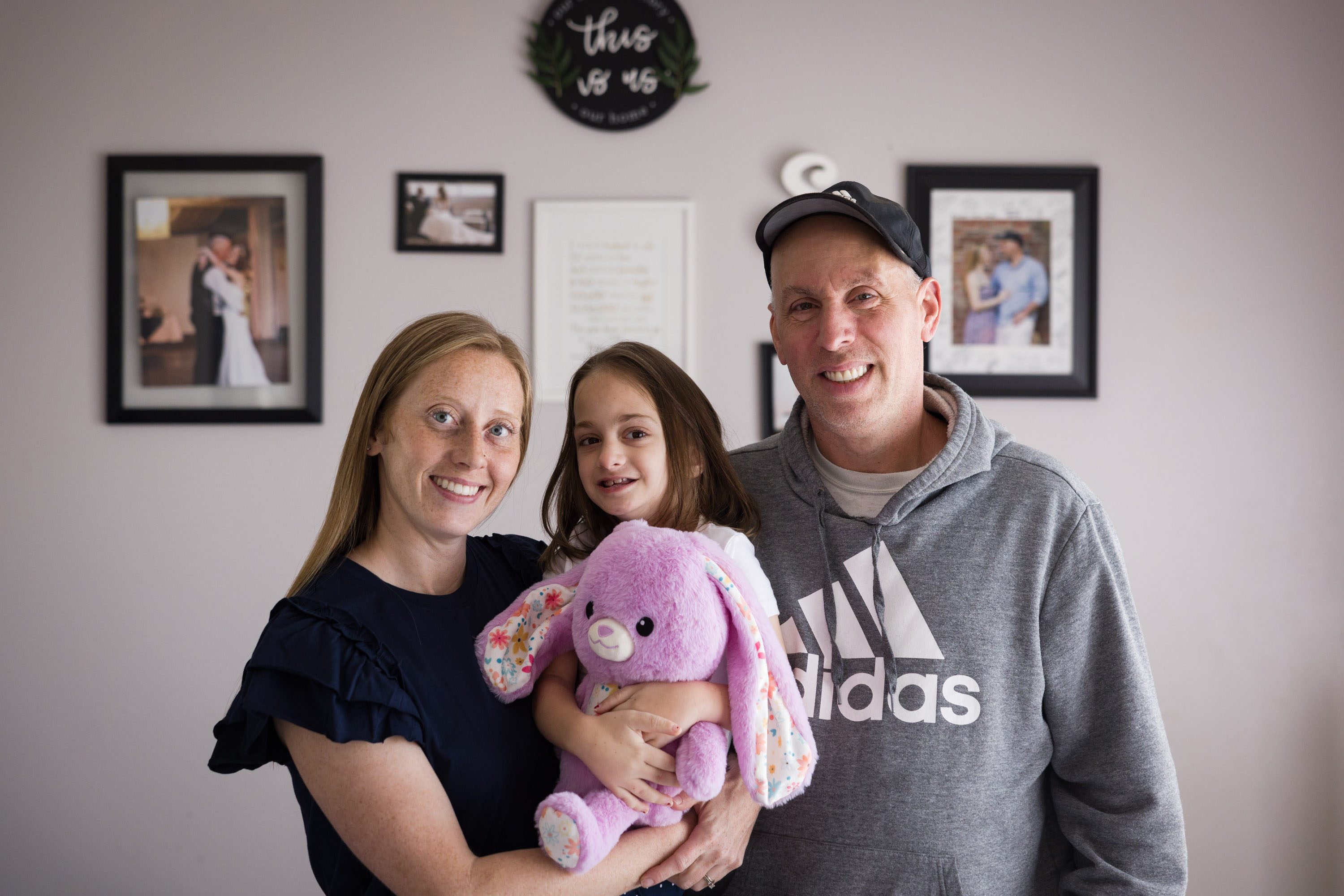
When we think of AI and our health, many of us are skeptical. But for Nicole, having access to Lenox Hill Radiology Center’s/RadNet Affiliated Imaging Centers’ AI-assisted early breast cancer screening technology helped avoid the anxiety of additional callbacks and testing after her screening mammogram.
When she got her first screening mammogram at the age of 41, Nicole didn’t expect the uncertainty that might come with a result that required several follow-ups to determine there were no abnormalities.
“After that initial diagnostic mammogram, without the AI, I had to get a callback for an ultrasound, which led to a stereotactic biopsy and another additional unilateral mammogram,” King explained. “It was a very scary time, and obviously not the best experience in terms of comfort.”
We spoke with Dr. Greg Sorenson, Executive Vice President at RadNet, about how the Enhanced Breast Cancer Detection (EBCD) process and technology work, accessibility, eligibility, and why it can be beneficial for Black women.
What Does it Mean to Have Dense Breast Tissue?
Many of us are told that we have dense breast tissue; some doctors add ultrasounds to our screenings, others don’t. It is one of the reasons we may be called back for follow-ups.
“When we do a mammogram, we shoot X-rays through the breast. And that lets us see some of the tissue structures that are in there,” Dr. Sorenson explains. And in women, where the X-ray shows that they have dense tissue, what that means is that, like bone is hard, there are gradations, and some of the tissues in the breast absorb more of the X-rays.”
“There’s nothing, no correlation with how a breast feels or what it looks like when you look at it, other than the more fat that a breast has in it, the less dense it is,” Sorenson continues.
“And so as women get older and go through menopause, a lot of the tissues in their body do get replaced by fat. And so, typically, older women are less likely to have dense breast tissue, and younger women are more likely to have dense breast tissue.”
Dense Breast Tissue and Detecting Cancer
Dr. Sorenson notes that mammograms alone don’t always work well in the detection of breast cancer. He offers this analogy, “Breast cancer looks like a golf ball on a snow field. The snow field is the white, and the dense tissues. It’s like all snow or lots of snow in the fatty breast tissue; there are just patches of snow or maybe very little snow. When you are trying to find the golf ball, it is easier,” he says.
“But when you are a young woman with dense breasts, there are patches of snow, and so as you’re searching the field for that golf ball kind of that white thing, it makes it harder for us radiologists to do our job.”
That is why many of us often get an MRI or an ultrasound. Sorenson points out that there is more breast tissue involved when you have dense breast tissue.
“And because we think that cancer is more or less a statistical event. A combination of genetics, the environment, and statistical likelihood, if you have more breast tissue, we think you’re probably more likely to have one of those cells get a mutation in it that goes cancerous.”
How Does AI Technology Help in Detecting Breast Cancer?
The technology used in the EBCD helps radiologists find the golf balls, whether there is snow around them or not.
“Our data shows that they get a boost in helping find the golf balls when there’s not much dense tissue, but they get just as big, maybe even a little bit bigger, boost when there is dense tissue,” he notes.
The key is that the AI is not a replacement for the doctor or radiologist. “What RADNET has chosen to do is to use AI in two ways. One is to help the doctor look for the golf ball. But then, secondly, the AI itself looks for the golf ball.”
If an area of concern is flagged by AI, a safeguard reviewer, who is also a radiologist, is asked to review the file. What’s different about this program is that it is targeted. The safeguard review is a targeted peer review for the most dangerous cancer cases. So it brings in another doctor to essentially make sure there’s three sets of eyes, the first doctor, the AI, and then if needed, a second doctor.”
What is amazing is that RADNET offers this additional service to its mammogram patients for a total of $40. Most choose to do it as a self-pay option, but some employers already cover it.
How the AI-Assisted Screening Technology Helped Nicole
Unlike her first experience, Nicole qualified for the EBCD on her second mammogram because she had no areas of concern.
“When I was informed, ‘hey, you can qualify this time because you’re getting a screening mammogram. Honestly, I jumped on it, and it really reduced any callbacks. My next mam isn’t due until next year,” she explains. “Honestly, just gave me peace of mind, I must say.
The RADNET EBCD program is available in New York, New Jersey, Delaware, California, Arizona, and Houston, with some rural centers inside Walmart stores.









 English (US) ·